Shopping for home theater furniture doesn’t have to mean endless scrolling through generic online catalogs. Finding the right pieces locally lets homeowners test seating comfort, check build quality firsthand, and often get same-day delivery. Whether someone’s converting a spare bedroom into a cinema room or upgrading a basement entertainment space, the right furniture transforms movie nights from casual to cinematic. This guide walks through everything needed to source quality home theater furniture nearby, from essential pieces to measuring tactics that prevent costly returns.
Table of Contents
ToggleKey Takeaways
- Home theater furniture near you offers advantages like testing seating comfort, verifying exact dimensions, and accessing same-day or 48-hour delivery that online shopping can’t provide.
- Quality theater seating includes power recliners with steel mechanisms ($800–$1,500 per seat), sectional options for flexible layouts, and tiered stadium-style platforms that require structural permits for heights over 8 inches.
- Media consoles supporting home theater setups should weigh capacity for 75-100 pound TVs plus audio equipment, extend 3–6 inches beyond the screen on each side, and feature rear cable cutouts of at least 4 inches in diameter.
- Accurate space measurement prevents costly returns by checking doorway widths, ceiling heights, walkway clearances of 18–24 inches, and using painter’s tape to mock up furniture footprints before purchasing.
- Specialty AV stores, regional furniture chains, estate sales, and custom builders each offer different advantages—ask about floor model discounts and compare quality brands like Palliser, Seatcraft, and BDI when sourcing locally.
- Budget allocation should follow the 60/30/10 rule: 60% on seating, 30% on media consoles and storage, and 10% on accessories, with major sales events offering 20–40% discounts.
Why Local Shopping Matters for Home Theater Furniture
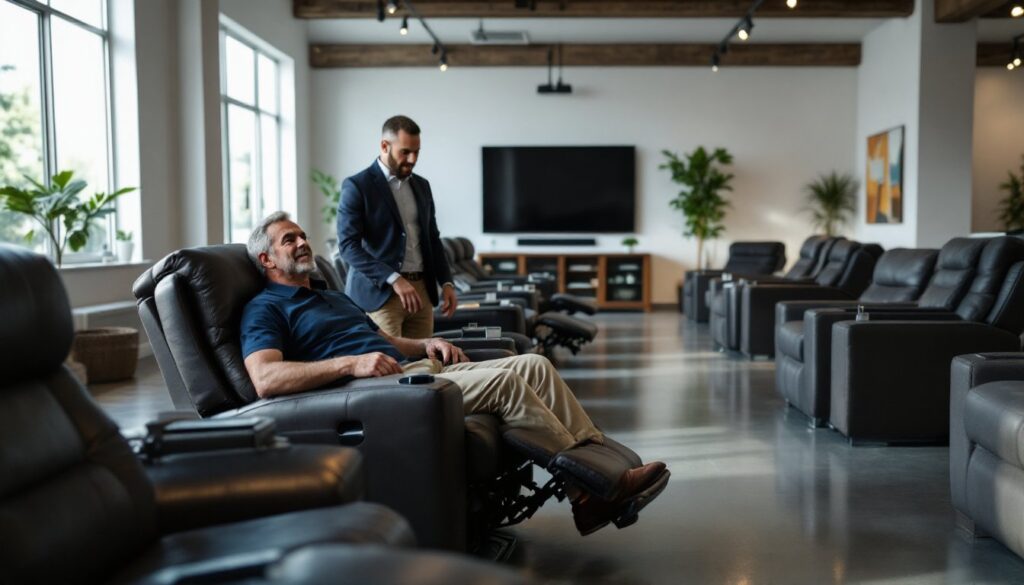
Buying home theater furniture from local retailers offers advantages that online shopping can’t match. Physical testing tops the list, recliner mechanisms vary wildly between brands, and what looks plush in photos might feel stiff after 20 minutes. Sitting in theater seats before purchasing reveals whether the lumbar support works for different body types and if armrest height interferes with cupholders.
Local stores also provide immediate size verification. A sectional that’s listed as 110 inches wide online might actually measure 112 inches with the recliners extended, which matters when dealing with tight basement doorways or low ceiling clearances. Staff can confirm actual dimensions versus nominal measurements.
Delivery logistics get simpler with local purchases. Most regional furniture stores offer delivery within 48 hours, and their crews know how to navigate tricky staircases or narrow hallways common in older homes. If a piece doesn’t fit, exchanges happen faster than shipping something back across the country.
Finally, local shopping supports warranty service. When a power recliner motor fails or a media console’s drawer track breaks, having a local service contact beats dealing with remote customer support and waiting for parts shipments.
Essential Types of Home Theater Furniture to Consider
Theater Seating Options
Theater seating falls into three main categories, each with trade-offs. Recliners remain the most popular choice, look for models with power headrests and lumbar support rather than manual pull-lever types. Quality recliners use steel mechanisms rather than plastic, which matters for longevity. Expect seats to measure 38–42 inches wide for singles, with dual-motor systems allowing independent control of footrest and backrest.
Sectional seating works well for families who want flexible arrangements. Modular sectionals let homeowners reconfigure layouts as needs change, and most include at least one reclining section. Check that sectional pieces lock together securely, cheap connectors create gaps that catch popcorn and remotes.
Loveseat-style theater seats split the difference, offering shared armrests with storage consoles between seats. These typically measure 60–70 inches wide and work in rooms where full sectionals overwhelm the space. Many include USB charging ports and LED cupholders, though these features add $200–$400 to base prices.
For authentic cinema feel, tiered seating platforms create stadium-style viewing. Building platforms requires framing with 2×8 or 2×10 joists (actual dimensions: 1.5″ × 7.25″ or 1.5″ × 9.25″) and ¾-inch plywood decking. This counts as structural work in most jurisdictions, check local codes before cutting studs or joists. Those comfortable with DIY furniture building can tackle simple platforms, but tiered systems exceeding 8 inches in height often require permits.
Media Consoles and TV Stands
Media consoles serve double duty: supporting TV weight and hiding cable clutter. Weight capacity matters more than aesthetics, a 75-inch TV weighs 75–100 pounds, and adding a soundbar and center channel speaker pushes total load past 120 pounds. Look for consoles with solid wood or engineered wood frames rather than particleboard, which sags over time.
Width guidelines follow a simple rule: the console should extend 3–6 inches beyond the TV on each side. A 75-inch TV (which actually measures about 65.4 inches wide) needs a console that’s 72–78 inches minimum. Oversized consoles look intentional: undersized ones look precarious.
Internal cable management separates good consoles from great ones. Rear cutouts should measure at least 4 inches in diameter to accommodate HDMI bundles, power strips, and ventilation. Adjustable shelves beat fixed ones, AV receivers need 6–8 inches of vertical clearance for heat dissipation, while streaming boxes fit in 3-inch spaces.
For rooms with built-in storage considerations, floating consoles create clean lines and simplify floor cleaning. These mount to wall studs using heavy-duty brackets rated for 150+ pounds. Standard studs sit 16 inches on center, use a stud finder rather than guessing, because drywall anchors won’t support TV furniture loads.
Some homeowners prefer custom media cabinets that integrate component storage with display space. These work especially well in multi-purpose rooms where theater equipment shares space with everyday living.
Where to Find Home Theater Furniture Locally
Specialty AV and furniture stores stock the widest selection of theater-specific seating. These retailers carry brands that focus on features like power recline, cooling cup holders, and storage consoles built into armrests. Staff typically understand room acoustics and can suggest layouts that don’t block speakers or create sightline issues.
Regional furniture chains offer mid-range options with faster delivery than national big-box stores. Many maintain warehouse stock of popular items, meaning a reclining sofa could arrive within days rather than weeks. These stores also negotiate more on price than national chains, ask about floor model discounts or package deals when buying multiple pieces.
Big-box home improvement stores increasingly stock media consoles and TV stands alongside their core inventory. The quality leans toward budget-friendly, but assembly is straightforward for anyone comfortable with basic woodworking projects. These retailers also sell materials for DIY builders creating custom solutions.
Estate sales and consignment shops sometimes yield high-end theater furniture at steep discounts. Leather recliners and solid wood media consoles hold value well if they’ve been maintained. Inspect mechanisms carefully, replacing a recliner motor costs $150–$300, which eats into savings. Look for brands known for longevity: Palliser, Seatcraft, and Octane for seating: BDI and Salamander for media furniture.
Custom furniture builders provide solutions for awkward spaces or specific requirements. A local woodworker can build a media console that fits a sloped ceiling or accommodates an unusual equipment stack. Costs run higher, expect $800–$2,000 for a custom console versus $400–$800 for retail equivalents, but the piece fits perfectly and uses preferred materials.
For those prioritizing locally-sourced furniture options, asking retailers about regional manufacturers sometimes reveals surprising options that combine quality with shorter lead times.
How to Measure Your Space Before Shopping
Start with room dimensions, measuring wall-to-wall at floor level. Baseboards and carpet add bulk that throws off estimates, measure to the actual wall surface. Note any obstacles: floor vents, electrical outlets, light switches, and cable ports all affect furniture placement. Outlets should sit at least 3 inches away from furniture backs to allow plugs to insert without forcing.
Map out walkway clearances next. Theater rooms need 18–24 inches of clearance for comfortable passage, and more if doors swing into the space. Measure from the furniture footprint’s outermost point when recliners extend, some models add 20+ inches when fully reclined.
Check ceiling height, especially in basements or rooms with soffits. Tiered seating platforms eat vertical space quickly: a 12-inch riser plus a recliner with a 42-inch seat back height puts heads at 54 inches, leaving only 42 inches to an 8-foot ceiling. Anyone taller than 6 feet will feel cramped.
Doorway dimensions catch most DIYers off guard. Measure door openings at the narrowest point, typically the jamb width (30–36 inches for standard doors). Then measure sectional or recliner pieces diagonally, many can’t navigate tight turns even if they technically fit through openings. If furniture must go downstairs, measure stairwell width and any ceiling height restrictions where stairs turn.
Viewing distance determines seating placement. For 4K TVs, the ideal viewing distance equals 1.5 times the screen width. A 75-inch TV (65.4 inches wide) looks best from about 8 feet away. For 1080p displays, double that distance to avoid seeing pixels. Measure from where seat backs will rest, not from the wall behind them.
Use painters tape to mock up furniture footprints on the floor before buying. This reveals traffic flow issues and helps visualize scale better than measurements alone. Include space for side tables or snack trays if those are part of the plan.
For rooms with unique layout challenges, photographing the space from multiple angles helps store staff suggest appropriate pieces when shopping locally.
Budget Planning for Your Home Theater Furniture
Theater furniture costs vary enormously based on materials, features, and brand. Entry-level recliners start around $400–$600 for manual models with bonded leather or polyester upholstery. These work fine for occasional use but won’t hold up to nightly movie sessions, bonded leather peels within 2–3 years of regular use.
Mid-range power recliners with genuine leather or performance fabrics run $800–$1,500 per seat. At this price point, expect USB ports, adjustable headrests, and steel reclining mechanisms. These represent the sweet spot for most homeowners balancing quality and cost. Performance fabrics resist stains better than leather and cost $100–$200 less per seat.
Premium theater seating ($1,800–$3,500 per seat) includes features like heating, cooling, massage functions, and ambient LED lighting. Materials upgrade to top-grain leather with reinforced stitching. These make sense for dedicated theater rooms with daily use, but they’re overkill for casual viewing spaces.
Media consoles span an equally wide range. Particleboard TV stands from big-box stores cost $150–$300 and suffice for small TVs in secondary rooms. Solid wood or quality engineered wood consoles run $500–$1,200, offering better durability and cable management. Custom built-ins start around $1,500 and climb quickly depending on size and complexity.
Don’t forget installation costs. Delivery and setup for theater seating typically adds $100–$200. Wall-mounting a TV runs $150–$300 unless homeowners handle it themselves, which requires finding studs, using appropriate lag bolts (typically ¼-inch × 3-inch for mounts up to 100 pounds), and ensuring the mount is level.
Budget allocation should follow the 60/30/10 rule: 60% on seating, 30% on the media console and storage, 10% on accessories like side tables and lighting. For a $3,000 budget, that means $1,800 for seating (three mid-range recliners), $900 for a quality media console, and $300 for finishing touches.
Regional pricing matters. Furniture costs 15–25% more in major metros versus rural areas, and local labor rates affect custom work and installation. Sales cycles run predictably, Presidents’ Day, Memorial Day, and Black Friday bring the deepest discounts, typically 20–40% off.
For those juggling multiple furniture needs, comparing options at furniture retailers specializing in home comfort can reveal package deals that reduce per-piece costs.
Financing options exist but come with caveats. Zero-percent promotional financing works only if the balance is paid before the promo period ends, otherwise, deferred interest gets applied retroactively at rates often exceeding 25% APR. Cash purchases sometimes unlock additional discounts of 5–10%.
Finding quality home theater furniture locally comes down to knowing what to look for, measuring carefully, and understanding real costs versus advertised prices. The right pieces turn a room into an entertainment destination that holds value for years.