French country bedroom furniture brings the charm of rural Provence into modern homes with a blend of weathered finishes, carved details, and relaxed sophistication. It’s not about pristine showroom pieces, this style celebrates age, texture, and the kind of lived-in comfort that makes a bedroom feel like a retreat. Whether someone’s furnishing a master suite or updating a guest room, understanding what makes French country furniture authentic helps avoid the traps of generic “farmhouse” knockoffs that miss the mark entirely. This guide walks through the defining characteristics, essential pieces, materials, and practical layout strategies needed to pull off the look with confidence.
Table of Contents
ToggleKey Takeaways
- French country bedroom furniture is defined by weathered finishes, carved details, and lived-in authenticity rather than pristine showroom pieces that lack character and age.
- Authentic French country bedroom furniture emphasizes natural materials like solid oak, cherry, and fruitwood with distressed or painted finishes in soft whites, creams, and pale grays, paired with wrought iron or aged brass hardware.
- Essential pieces include an upholstered or carved wood headboard at 24-30 inches total height, a quality dresser or armoire with dovetail joinery, and mismatched nightstands that feel collected over time rather than purchased as a set.
- Achieve authentic distressing by sanding edges, corners, and areas around hardware with 120-150 grit sandpaper, then apply brown glaze or dark wax into crevices to mimic natural wear without overdoing it.
- Arrange French country bedroom furniture by centering the bed on the longest wall with 36 inches of clearance for nightstands, using layered warm lighting, and adding a bench or settee at the foot for balanced visual weight.
- Quality French country pieces come from estate sales, antique dealers, or specialized retailers using solid hardwood construction; alternatively, DIYers can build headboards and benches affordably or reupholster vintage frames for significant savings.
What Defines French Country Bedroom Furniture?
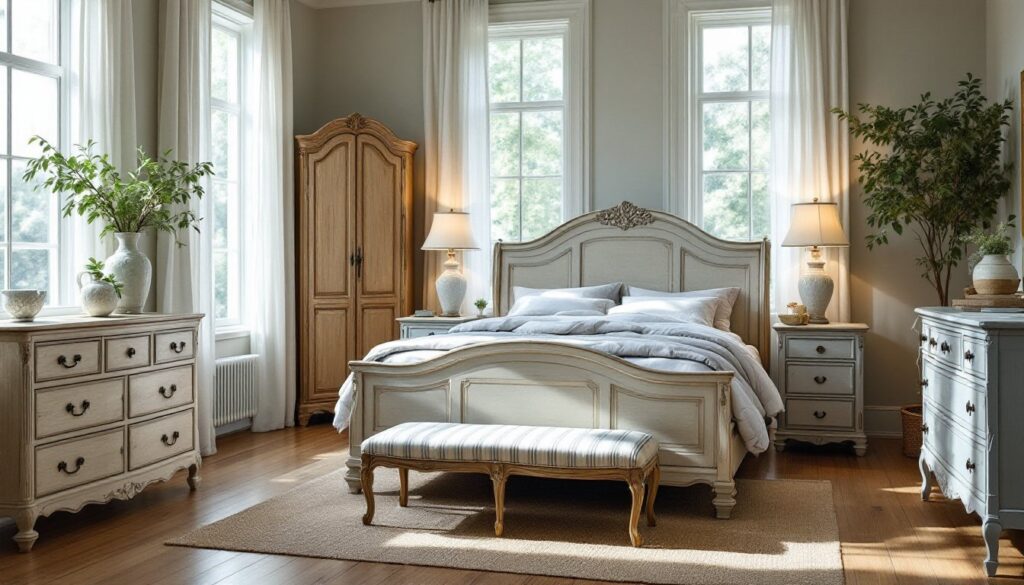
French country furniture differs from other rustic styles through its specific combination of provincial practicality and understated elegance. The pieces often feature distressed or painted finishes, typically soft whites, creams, pale grays, or weathered blues, that suggest decades of use rather than factory-applied aging. Look for carved details on legs, drawer fronts, and headboards: acanthus leaves, floral motifs, and gentle curves instead of the stark geometry found in Shaker or Scandinavian designs.
Natural materials dominate. Solid oak, cherry, and fruitwoods appear frequently, often with visible grain that shows through thin washes of paint or wax. Hardware tends toward wrought iron or aged brass, think hand-forged pulls, escutcheons, and hinges that show some patina. Unlike formal French Provincial furniture (which leans Louis XV with gilding and marquetry), French country style skips the ostentation. It’s what a farmhouse in Avignon would hold, not a Parisian salon.
Proportions lean traditional but not heavy. Bed frames sit lower than ornate four-posters but higher than platform beds. Dressers and armoires offer generous storage without the bulk of Victorian pieces. The overall effect should feel collected over time, not purchased as a matched set from a single manufacturer. That deliberate mismatch, one nightstand slightly different from the other, or a bench that doesn’t precisely match the bed frame, reinforces the lived-in authenticity central to French style bedroom furniture.
Essential French Country Bedroom Furniture Pieces
Beds and Headboards
The bed anchors any French country bedroom. Upholstered headboards in linen or ticking stripe are common, often with simple tufting or nailhead trim. Wood headboards work equally well, look for gently curved tops, planked panels, or carved details at the crest rail. Sleigh beds with scrolled footboards fit the style, especially in weathered oak or painted finishes, but avoid anything too shiny or formal.
Frame height matters. French country beds typically sit 18 to 24 inches off the floor (mattress top height around 24 to 30 inches total), which allows for a bed skirt and gives the piece visual presence without requiring a step stool. Avoid ultra-low platform frames or towering four-posters unless they’re genuinely antique. If someone’s building or refurbishing a headboard, use 1×6 or 1×8 pine boards with a distressed paint finish and simple corbels or brackets for mounting.
Dressers and Armoires
French country bedrooms favor armoires over built-in closets when space allows. These freestanding cabinets, often 60 to 80 inches tall, provide hanging space, shelves, and drawers while serving as a focal point. Authentic pieces use mortise-and-tenon joinery and may have shaped aprons, bracket feet, or paneled doors with wrought-iron hardware. If buying new, check that door panels are solid wood or quality veneer, not particleboard with a photo finish.
Dressers range from three to nine drawers and often feature slightly bowed fronts (bombé shape) or carved drawer faces. Drawer boxes should use dovetail or dowel joints, anything stapled together won’t hold up. For DIYers refinishing a vintage dresser, strip old varnish with a quality stripper (wear nitrile gloves and respirator), sand to 220 grit, then apply a wash of diluted chalk paint or milk paint. Lightly distress edges with 120-grit sandpaper where natural wear would occur, drawer pulls, corners, and the top edge. Seal with clear wax or a matte poly.
Nightstands should offer at least one drawer and an open shelf. Mismatched pairs feel more authentic than identical twins, as long as they’re similar in height (typically 24 to 28 inches to align with mattress height). Small chests, vintage stools, or even stacked trunks can substitute if storage needs are minimal.
Materials and Finishes That Capture the French Country Style
Oak is the workhorse wood of French country furniture, durable, easy to distress, and historically common in rural France. White oak shows tighter grain than red oak and takes paint washes better. Cherry and walnut appear in higher-end pieces, offering richer tones that need little more than an oil finish. Pine works for budget builds or painted pieces, though it dents easily: use it for headboards, bed frames, or accent furniture rather than drawer boxes that see heavy use.
Finishes should look aged, not pristine. Milk paint provides the chalky, slightly uneven surface characteristic of old French furniture. It chips naturally over time, especially over a coat of wax or bonding agent, embrace that. Chalk paint offers similar aesthetics with easier application but can feel too matte: a coat of clear or dark wax adds depth. For a more durable finish on high-touch surfaces like dresser tops, use satin or matte polyurethane over a painted or stained base. Skip high-gloss anything.
When design trends shift toward rustic interiors, distressing becomes even more popular. To distress convincingly, focus on edges, corners, and areas around hardware, places where decades of hands and cleaning would naturally wear away finish. Use 120- to 150-grit sandpaper and work gently: overdoing it looks fake. A little brown glaze or dark wax rubbed into crevices and wiped back adds shadow that mimics accumulated grime.
Hardware should be iron, bronze, or brass, nothing chrome or brushed nickel. Bin pulls, drop pulls, and simple knobs fit better than ornate handles. If replacing hardware on a vintage piece, keep the original holes: drilling new ones weakens drawer fronts. Fill old holes with wood filler, sand flush, then redrill if absolutely necessary.
How to Arrange French Country Furniture in Your Bedroom
Start with the bed centered on the longest wall unless windows or doors make that impractical. Leave at least 30 inches of clearance on each side for nightstands and easy access, 36 inches feels more comfortable. If the room is narrow, float the bed away from the wall slightly (6 to 12 inches) to create a buffer and make bedmaking easier.
Place nightstands within arm’s reach of the bed. They don’t need to match, but they should be close in height, a 4-inch difference starts to look off. Use table lamps with linen or burlap shades rather than overhead lighting as the primary source: French country style relies on layered, warm lighting to create ambiance.
Position the dresser or armoire on a wall perpendicular to the bed if space allows, balancing the room’s visual weight. If the armoire is large (over 60 inches wide), it can dominate a small room, consider placing it in a walk-in closet or adjacent dressing area instead. Measure doorways and hallways before buying: many armoires don’t fit through standard 30- or 32-inch doors without disassembly.
Add a bench or settee at the foot of the bed for a layered look and a practical spot to sit while putting on shoes. Upholstered pieces in ticking stripe, linen, or even a vintage grain sack work well. A small writing desk near a window fits the style and adds function, especially in a guest room. Keep the floor mostly clear, French country isn’t cluttered, just comfortably furnished.
Rugs should be natural fiber or vintage-style wool. A 9×12 area rug under a queen bed leaves enough overhang on three sides. Jute, sisal, or faded Persian patterns fit the aesthetic better than bright geometric prints. Avoid wall-to-wall carpet if possible: wide-plank hardwood or distressed laminate flooring reinforces the rustic theme.
Where to Find Quality French Country Bedroom Furniture
Estate sales and auctions remain the best sources for authentic vintage pieces. Bring a tape measure, a flashlight, and someone who can help load furniture. Check drawer construction (dovetails, not staples), test hinges and slides, and look for solid wood rather than veneer over particleboard. Refinishing a solid vintage dresser costs less than buying new pressed-wood furniture that won’t last a decade.
Antique malls and consignment shops curate inventory more than estate sales but charge accordingly. Ask about provenance, genuine French or European pieces command higher prices than American reproductions, though quality reproductions from the mid-20th century can be excellent. Many regional design publications highlight local sources for country furniture, especially in areas with strong French cultural influence.
For new furniture, look for makers who use solid hardwood construction, dovetail joinery, and hand-applied finishes. Avoid big-box stores selling particleboard cores with a thin veneer, those pieces won’t survive a single move. Online retailers specializing in farmhouse or cottage style offer decent options: read reviews carefully and confirm return policies, especially for large pieces. Expect to pay $800 to $1,500 for a quality new dresser, $1,200 to $2,500 for an armoire, and $600 to $1,200 for a solid wood bed frame.
DIYers can build simpler pieces, headboards, benches, nightstands, using standard dimensional lumber. A basic headboard requires a sheet of 3/4-inch plywood (cut to width), 1×4 or 1×6 trim boards for a frame, wood glue, finishing nails, and bed frame mounting brackets. Paint, distress lightly, seal with wax, and mount to the wall or attach directly to the bed frame. Total material cost runs $75 to $150 depending on lumber prices, and the project takes a weekend.
For upholstered pieces, buying vintage frames and having them reupholstered in linen or ticking costs less than new custom furniture. Expect $400 to $800 for a basic headboard reupholstery depending on size and fabric. Provide the upholsterer with your fabric, they’ll charge less than if they source it, and specify simple details like single-needle stitching or small nailhead trim to keep costs down.