Walking into a living room where every piece feels intentional, balanced, and somehow just right isn’t magic, it’s the result of smart furniture selection. Furniture collections take the guesswork out of creating a cohesive look by bundling complementary pieces designed to work together. Instead of spending weekends hunting for a sofa that matches the chair you bought three months ago, collections offer a ready-made framework. They’re not about sacrificing personality: they’re about giving yourself a solid foundation to build on. Whether renovating a dated space or furnishing a new home, understanding how collections work, and how to adapt them, saves time, money, and buyer’s remorse.
Table of Contents
ToggleKey Takeaways
- Living room furniture collections eliminate guesswork by bundling complementary pieces with matching materials, finishes, and proportions designed to work seamlessly together.
- Choose between traditional collections (eight-way hand-tied springs, rich wood tones) for formal spaces or modern collections (modular, performance fabrics, clean lines) for open floor plans based on your home’s architecture.
- Measure room dimensions, doorways, ceiling height, and seating needs before selecting a collection to ensure pieces fit functionally and proportionally in your space.
- Collections provide a foundation for personal style—anchor with the largest piece, then introduce variety through accent chairs, contrasting tables, and strategic pillows to avoid a showroom appearance.
- Material durability matters: homes with kids or pets should prioritize performance-grade upholstery rated 30,000+ double rubs, while finish compatibility with existing trim prevents visual clashing.
What Are Living Room Furniture Collections and Why Choose Them?
A furniture collection is a curated grouping of pieces, typically sofas, loveseats, chairs, ottomans, and sometimes tables, designed by the same manufacturer with matching materials, finishes, and proportions. Think of it as a kit: the joinery, fabric patterns, leg styles, and scale are engineered to coordinate.
The practical advantage? Consistency in quality and sizing. A sofa and loveseat from the same collection share seat height, arm width, and cushion fill, which means they’ll wear evenly and look balanced side-by-side. No wondering if that armchair will dwarf the sofa or clash with the wood tone.
Collections also simplify the buying process. Instead of cross-referencing paint swatches and fabric samples across three different stores, buyers can select a set, add or subtract pieces based on room size, and move forward. This doesn’t mean every room looks cookie-cutter, most collections offer multiple upholstery options, configurations (sectionals vs. standard sofas), and modular components.
For DIYers managing a full-room refresh, collections reduce decision fatigue. You’re not starting from scratch: you’re choosing a direction and customizing from there. That focus allows more energy for the details that actually personalize a space: lighting, art, rugs, and accent furnishings that reflect regional character.
Types of Living Room Furniture Collections to Consider
Collections fall into broad style categories, each with distinct construction methods, materials, and visual language. Knowing the difference helps match furniture to both the home’s architecture and the household’s actual use.
Traditional and Classic Collections
Traditional collections lean on historical design cues: rolled arms, turned legs, tufted backs, and rich wood tones like cherry, mahogany, or walnut. Fabrics trend toward damasks, velvets, and heavyweight wovens (12+ oz per yard), built to handle daily use without pilling.
Construction often includes eight-way hand-tied springs, a frame system where each spring is knotted to its neighbors in eight directions, creating even weight distribution and long-term support. It’s overkill for a guest room settee, but for a family room sofa pulling daily duty, it’s the difference between sagging cushions in three years or ten.
These collections suit homes with architectural details: crown molding, wainscoting, or divided-light windows. They also pair well with hardwood floors and area rugs, where the furniture’s heft balances the room’s formality. If the home has a fireplace with a stone or brick surround, traditional pieces echo that permanence.
Practical note: solid wood frames and dense cushion cores make traditional furniture heavy. Plan for two people and a furniture dolly when arranging. Also, many regional furniture styles emphasize classic proportions with generous seating depths, measure doorways and stairwells before delivery.
Modern and Contemporary Collections
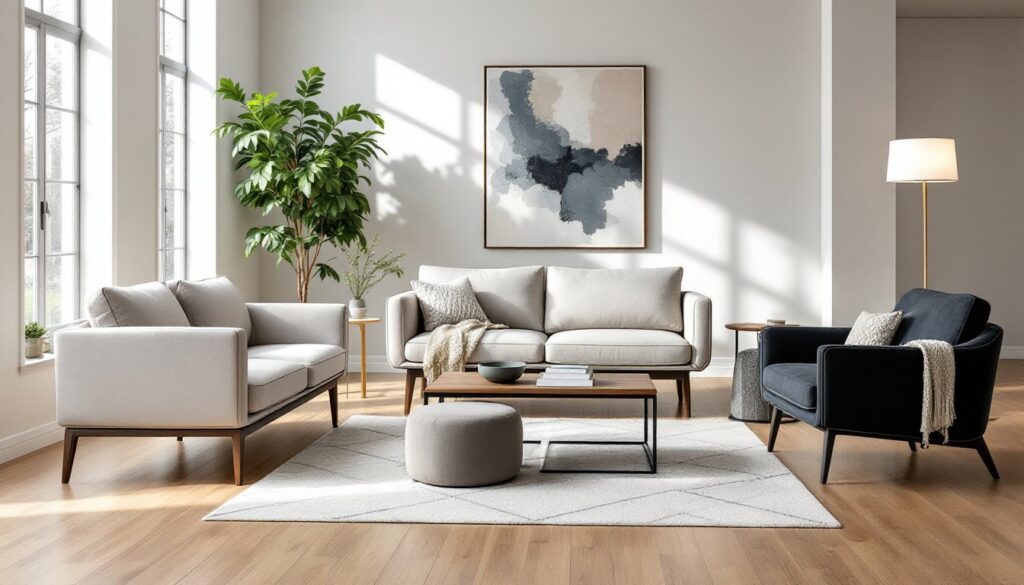
Modern and contemporary collections prioritize clean lines, low profiles, and modular flexibility. Arms are track-style or absent entirely: legs are often tapered metal, walnut, or angled wood. Upholstery skews toward performance fabrics, polyester blends treated for stain resistance and fade protection, or leather in matte finishes.
Frames may use sinuous (no-sag) springs instead of eight-way ties. These S-shaped wire springs run front-to-back and are clipped to the frame. They’re lighter, less expensive, and perfectly adequate for moderate use. High-density foam (2.0+ lbs per cubic foot) is standard in seat cushions, sometimes layered over a pocketed coil core for added support without the bulk.
Contemporary collections often include sectionals with movable chaises or armless middle seats that reconfigure as needs change. This modularity suits open-floor plans where the living area flows into dining or kitchen spaces. Pieces are designed to float in a room, not anchor against walls.
Style-wise, these collections work in homes with large windows, neutral palettes, and minimal trim. They also complement industrial elements: exposed ductwork, concrete floors, or steel beams. According to leading design resources, modern collections often incorporate mixed materials, think a linen sofa with blackened steel legs or a velvet chair on a birch plinth base.
Be mindful of scale. Low-backed modern sofas can disappear in a room with 9-foot ceilings or higher. If the space has vertical volume, consider collections with taller backs or add visual height through floor lamps and vertical art.
How to Choose the Right Collection for Your Space
Start with room dimensions and traffic flow, not aesthetics. Measure the room’s length, width, and any architectural interruptions, fireplaces, built-ins, radiators, windows within 18 inches of the floor. Note doorway widths (standard interior doors are 30-32 inches, but older homes may be narrower) and ceiling height.
Seating capacity comes next. Count the number of people who’ll regularly use the space, then add one. A family of four needs seating for five to accommodate guests without cramping. A sofa typically seats three, a loveseat two, an armchair one. Sectionals vary, measure total linear seating length and divide by 22 inches per person (the ergonomic minimum).
Test seat depth and height in person if possible. Standard seat depth is 20-22 inches: deeper seats (24+ inches) suit tall users but can leave shorter folks with legs dangling. Seat height should allow feet to rest flat when sitting upright, typically 17-19 inches from the floor. Collections targeting “lounge” use may go lower (15-16 inches), which looks sleek but makes standing difficult for anyone with knee issues.
Consider material durability relative to household activity. Homes with kids, pets, or heavy use need performance-grade upholstery rated for 30,000+ double rubs (a measure of abrasion resistance). Leather is durable but shows scratches: microfiber and treated polyester blends hide wear better. Light fabrics in high-traffic areas are a maintenance burden, plan for slipcovers or darker tones.
Finish compatibility matters for wood elements. If the room has oak trim or cabinetry, a collection with cherry or espresso finishes may clash. Match undertones: warm (golden, red) or cool (gray, taupe). Bring a trim sample or photo when shopping.
Budget realistically. Mid-range collections (kiln-dried hardwood frames, sinuous springs, high-density foam) start around $2,000-$4,000 for a sofa, depending on region and retailer. Higher-end pieces with eight-way ties and premium fabrics run $4,000-$8,000+. Prices fluctuate with lumber costs and shipping: 2026 pricing reflects some easing from 2021-2023 spikes but remains above pre-pandemic levels. Many furniture retailers offer modular pricing, letting buyers add pieces over time rather than committing to a full set upfront.
Finally, check lead times. Custom upholstery can take 8-16 weeks: stock pieces ship in 2-6 weeks. If furnishing on a deadline (moving date, holiday hosting), confirm availability before committing.
Mixing and Matching Within Collections for Personal Style
Collections aren’t meant to be bought whole-cloth. The goal is cohesion, not uniformity. Strategic mixing within and beyond a collection creates depth without visual chaos.
Start by anchoring with the largest piece, usually a sofa or sectional, from the collection. This establishes the room’s color palette, material quality, and scale. Then layer in contrasting elements.
Accent chairs are the easiest place to introduce variety. If the sofa is a neutral linen, choose a chair from the same collection in a bold pattern or texture: a geometric chenille, a leather finish, or a velvet in a saturated hue. Many collections offer 6-12 fabric options across the same frame, letting buyers shift tone without abandoning the coordinated look. Design experts recommend balancing neutral foundations with strategic color accents to add personality without overwhelming the space.
Alternatively, pull an accent chair from outside the collection entirely. A mid-century armchair with tapered legs can complement a contemporary sofa if the seat height and arm height are within 2-3 inches of each other. Wildly mismatched proportions break the visual rhythm.
Ottomans and benches add flexibility. A matching upholstered ottoman serves as overflow seating, a footrest, or a coffee table with a tray on top. A contrasting wood bench introduces textural variety and doesn’t compete with the sofa’s profile.
Tables, coffee, end, console, don’t need to match the collection’s wood finish. In fact, a metal and glass coffee table often balances a fabric-heavy room better than another upholstered piece. If the collection includes wood legs, echo the tone (warm vs. cool) in the table, but mixing finishes, say, walnut sofa legs with a lighter oak end table, adds dimension, as noted by home design authorities.
Throw pillows and blankets are the final layer. Collections sometimes offer coordinating pillows, but adding 2-3 pillows in a pattern or color not found in the set prevents the room from looking like a showroom floor. Stick to a consistent color family (analogous colors on the color wheel) or use a repeating accent color to tie disparate elements together.
Avoid the “matchy-matchy” trap: identical end tables, identical lamps, identical everything. Symmetry works for formal spaces, but most living rooms benefit from balanced asymmetry, two different lamps of similar height, or one large piece of art instead of two smaller identical prints.
If working with multiple collections, say, a statement piece from a celebrity-endorsed line paired with foundational seating, ensure shared elements. Match one of three: color, material, or scale. All three creates redundancy: none creates discord.
Conclusion
Furniture collections offer a practical framework, not a straitjacket. They solve the hardest part of furnishing a living room: making sure individual pieces work together in scale, quality, and style. But the best rooms layer personal choices over that foundation. Measure carefully, test in person when possible, and don’t buy the whole set if half of it doesn’t fit the space or the household’s real use. A cohesive living room happens when the structure is solid and the details are yours.